JKSSB FAA Syllabus 2026: The Jammu and Kashmir Service Selection Board (JKSSB) is inviting online online applications from eligible candidates for Finance Accounts Assistant (FAA) in various departments. Eligible candidates can submit their online applications from 08 December 2025 to 08 January 2026 through the official portal @jkssb.nic.in. The candidates must have completed bachelor’s degree with 50% marks and 45% for reserved categories to be eligible. Additionally, aspirants age must be between 18 to 40 years with age relaxation to reserved categories in accordance with government rules and regulations. There are approximately 600 vacancies (provisionally) distributed among various categories. The JKSSB FAA Syllabus 2026 is provided below in the post. For more details, read the complete article.
JKSSB FAA Syllabus 2026- Overview:-
| Organization | Jammu and Kashmir Services Selection Board (JKSSB) |
| Category | Exam News |
| Post Name | Accounts Assistant |
| No of Posts | 600 |
| Salary | Level-5 (29200-92300) |
| Qualification | Graduation with 50% (OM)/45% (Reserved) or PG with 50% or PhD |
| Age Limit | 18 to 40 years |
| Start Date for Apply | 08.12.2025 |
| Last Date for Apply | 06.01.2026 |
| Official Website | www.jkssb.nic.in |
| JKSSB FAA WhatsApp Group Link | JOIN NOW |
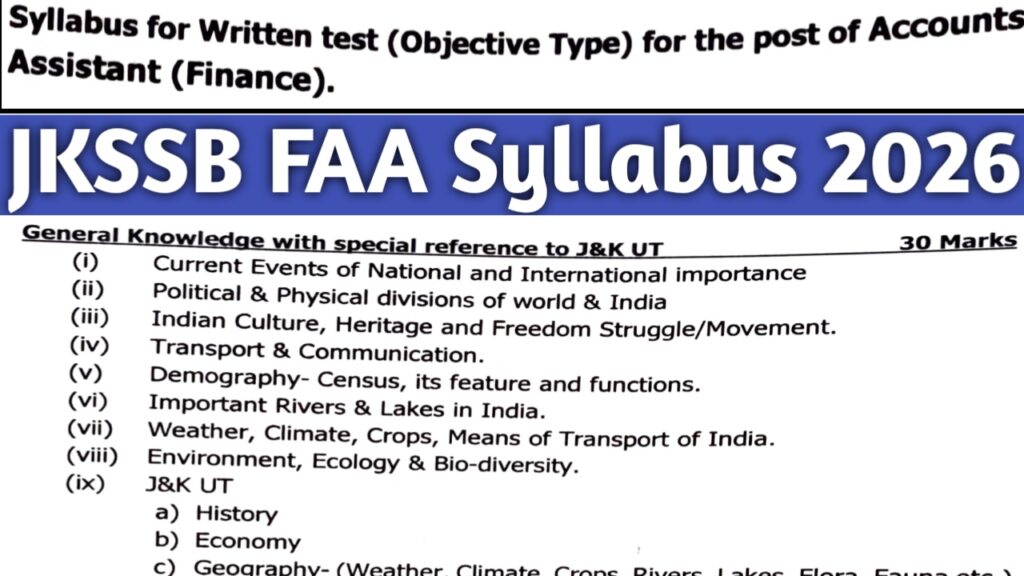
General Knowledge (with special reference to J&K UT) (30 Marks):-
- Current events of national and international importance.
- Political and physical divisions of the world and India.
- Indian culture, heritage, and the freedom struggle/movements.
- Transport and communication.
- Demography, including census features and functions.
- Important rivers and lakes of India.
- Environment, ecology, and biodiversity.
- Jammu & Kashmir Union Territory, including:
- a) History
- b) Economy
- c) Geography (weather, climate, crops, rivers, lakes, flora, fauna, etc.)
- d) Heritage and culture
- e) Important tourist destinations
- Jammu & Kashmir Reorganisation Act, 2019.
Accountancy and Book Keeping- (30 Marks):-
This section includes the following topics:
- Introduction to financial accounting and related terms.
- Accounting equation and journal.
- Elements of double entry bookkeeping.
- Trial balance.
- Cash book.
- Voucher approach in accounting.
- Bank reconciliation statement.
- Trading account.
- Profit and loss account.
- Balance sheet.
GENERAL ENGLISH- (10 Marks):-
- Tenses
- Rearranging of jumbled sentences
- Narration
- Modals
- Articles
- Comprehension with blanks to be filled using:
- Phrases
- Pronouns
- Homonyms / Homophones
- Clauses
- Synonyms and antonyms
- Pairs of words and their use in meaningful sentences
- Idioms and phrases
- Uses of prepositions
- Active and passive voice
STATISTICS- (10 Marks):-
- Primary and secondary data
- Methods of collecting primary and secondary data
- Preparation of questionnaires
- Tabulation and compilation of data
- Measures of central tendency
- Theory of probability
- Theory of attributes: basic concepts and applications
- Theory of index numbers, tests of index numbers, wholesale and consumer price index numbers
- Demography: census, its features and functions
- Vital statistics: measures of fertility, crude fertility rate, specific fertility rate, gross and net reproduction rates, measures of mortality
MATHEMATICS- (10 Marks):-
- Simple and compound interest
- Linear equations with two variables
- Permutations and combinations
- Binomial theorem
- Limits and derivatives
- Set theory: basic concepts and applications
- Relations and functions
- Matrices and determinants
- Probability
- Coordinate geometry, three-dimensional geometry, and vectors
GENERAL ECONOMICS– (10 Marks):-
- Introduction to economics: basic concepts and principles
- Fiscal and monetary policy: meaning, scope, and methodology
- Theory of consumer demand using indifference curve technique
- Demand analysis
- Factor pricing: marginal productivity theory and Ricardian theory of rent
- Pricing under various forms of market
- Factors of production and laws of production
- Concept of economic growth and its measurement
- Characteristics and problems of developing economy
- Planning versus market economy
- Economic reforms in India
- Concept and measurement of national income
- Role of RBI
GENERAL SCIENCE– (10 Marks):-
- Newton’s laws of motion, mass, weight, acceleration, velocity, speed, etc.
- Electric current, power, energy, and voltage
- Chemical equations and their types
- Metals and non-metals: physical and chemical properties
- Sources of energy: conventional and non-conventional (solar, wind, tidal, biomass)
- Nutrition and its types
- Respiration
- Transportation of water, food, and minerals in plants
- Communicable and non-communicable diseases
- Vitamins and diseases related to vitamin deficiency
- Ecosystem: components, food chains, and food webs
- Environmental pollution, ozone layer and its depletion, greenhouse effect
KNOWLEDGE OF COMPUTERS– (10 Marks):-
- Basic applications of computers and their components
- Fundamentals of computer science
- Concept of open-source technologies
- Input and output devices
- Operating systems
- Knowledge of MS Word, MS Excel, MS Access, MS PowerPoint, and PDF
- Internet and e-mail
- Concept of computer virus and anti-virus
- Hardware and software
- Elements of computer processing system: hardware, CPU, peripherals, storage media
- Software: definition, role, categories, firmware, and human-ware
- Role of information technology in governance
Important Links:-
| JKSSB FAA WhatsApp Group Link | JOIN NOW |
| JKSSB FAA Syllabus 2026 | DOWNLOAD |
| Official Website | CLICK HERE |
FAQs:-
General English includes grammar topics such as tenses, narration, modals, articles, clauses, vocabulary (synonyms, antonyms, idioms), comprehension, prepositions, and active–passive voice.
This section includes computer basics, hardware and software, operating systems, MS Office tools, internet and email, computer viruses, open-source technologies, and the role of IT in governance.